Pages

Friday, December 17, 2010

Argan oil for antiaging

The Argan nut comes from the Argan tree and grows only in the South Western part of Morocco. From these Argan nuts, a very nutritious oil is extracted which is renowned for its antiaging properties. This antioxidant rich oil has become very popular for its use in cosmetics and also for its nutritional properties.
Argan oil as a cosmetic is a very potent anti aging, nourishing, and hydrating natural care product. Argan oil is rich in vitamin A and has a very high content of vitamin E, which is an extremely potent antioxidant; it stimulates the synthesis of good prostaglandins and inhibits the effects of aging.
Rich in essential fatty acids, Argan oil invigorates the skin by balancing and stimulating the natural physiologic process of the dermis cells. Argan oil is perfect for aging skins, it will deeply moisturise, protect, regenerate and nourish.
Some of the skin benefits of Argan oil are said to be:-
  • It noticeably reduces wrinkles and softens the skin
  • Argan oil is rich in proteins shown to tighten the skin and protect skin’s elasticity.
  • Argan oils promotes the speedy  regeneration of the skin by restarting vital functions of cells to prevent early aging due to external aggressions (sun, bad weather, pollution, stress, tobacco, etc.).
  • Argan oil is also known to help reduce scarring, and help prevent stretch marks caused by pregnancy and weight fluctuations.
  • Possesses a sebum regulating action for oily skin.
  • Significantly hydrates the skin by restoring its natural barrier and neutralizing free radicals.
For centuries, Berber women of this Morocco have produced Argan oil which was used for their consumption and traditional Moroccan medicine. The Berber women have also used it for their skin and hair for hundreds of years. The Argan tree is a protected species, and under the protection of UNESCO, Cooperatives that have been formed to save the Argan tree, and protect it. The cooperative regroups women from the area work together to produce the Argan oil- to preserve the Argan forest by finding a sustainable economic use for its products and improve the social and economic status of rural women. It is from these cooperatives that we source Argan oil from to ensure this valued tree is protected and sustained.

Properties and uses of Argan oil

Argan oil is an oil produced from the kernels of the argan tree, endemic to Morocco, that is valued for its nutritive, cosmetic and numerous medicinal properties. The tree, a relict species from the Tertiary age, is extremely well adapted to drought and other environmentally difficult conditions of southwestern Morocco. The species Argania once covered North Africa and is now endangered and under protection of UNESCO. The Argan tree grows wild in semi-desert soil, its deep root system helping to protect against soil erosion and the northern advance of the Sahara. This biosphere reserve, the Arganeraie Biosphere Reserve, covers a vast intramontane plain of more than 2,560,000 hectares, bordered by the High Atlas and Anti-Atlas Mountains and open to the Atlantic in the west. Argan oil remains one of the rarest oils in the world due the small and very specific growing areas.

Argan trees were first reported by the explorer Leo Africanus in 1510. An early specimen was taken to Amsterdam where it was cultivated by Lady Beaufort at Badminton House in 1711   

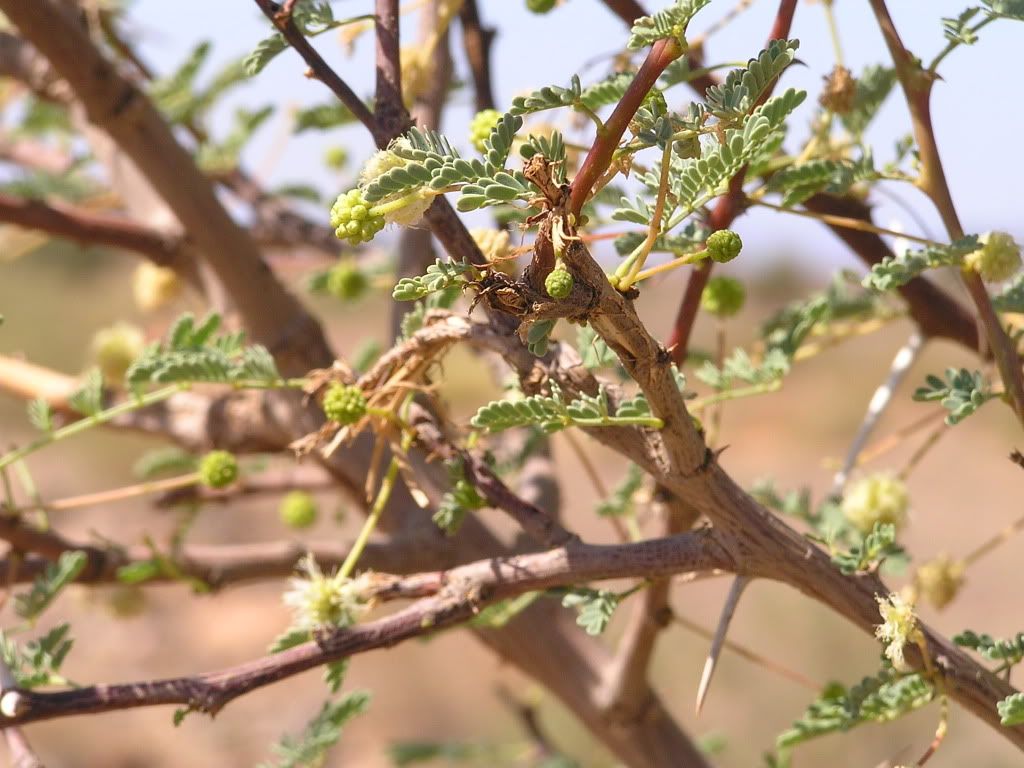
Argan grows to 8-10 metres high, and live to 150–200 years old. They are thorny, with gnarled trunks. The leaves are small, 2–4 cm long, oval with a rounded apex. The flowers are small, with five pale yellow-green petals; flowering is in April. The fruit is 2–4 cm long and 1.5–3 cm broad, with a thick, bitter peel surrounding a sweet-smelling but unpleasantly flavoured layer of pulpy pericarp. This surrounds the very hard nut, which contains one (occasionally two or three) small, oil-rich seeds. The fruit takes over a year to mature, ripening in June to July of the following year.   
   
Cultivation

In Morocco arganeraie forests now cover some 8,280 km² and are designated as a UNESCO Biosphere reserve. Their area has shrunk by about 50% over the last 100 years, owing to charcoal-making, grazing, and increasingly intensive cultivation. The best hope for the conservation of the trees may lie in the recent development of a thriving export market for argan oil as a high-value product.

Argan is also grown in Israel, in the Arava and Negev.

Uses

In some parts of Morocco, argan takes the place of the olive as a source of forage, oil, timber and fuel in Berber society. Especially near Essaouira, the argan tree is frequently climbed by goats.

Fruit

Argan fruit falls in July, when black and dry. Until that time, goats are kept out of the argan woodlands by wardens. Rights to collect the fruit are controlled by law and village traditions. The leftover nut is gathered after consumption by goats.

Oil
Argan savanna northeast of Taroudant

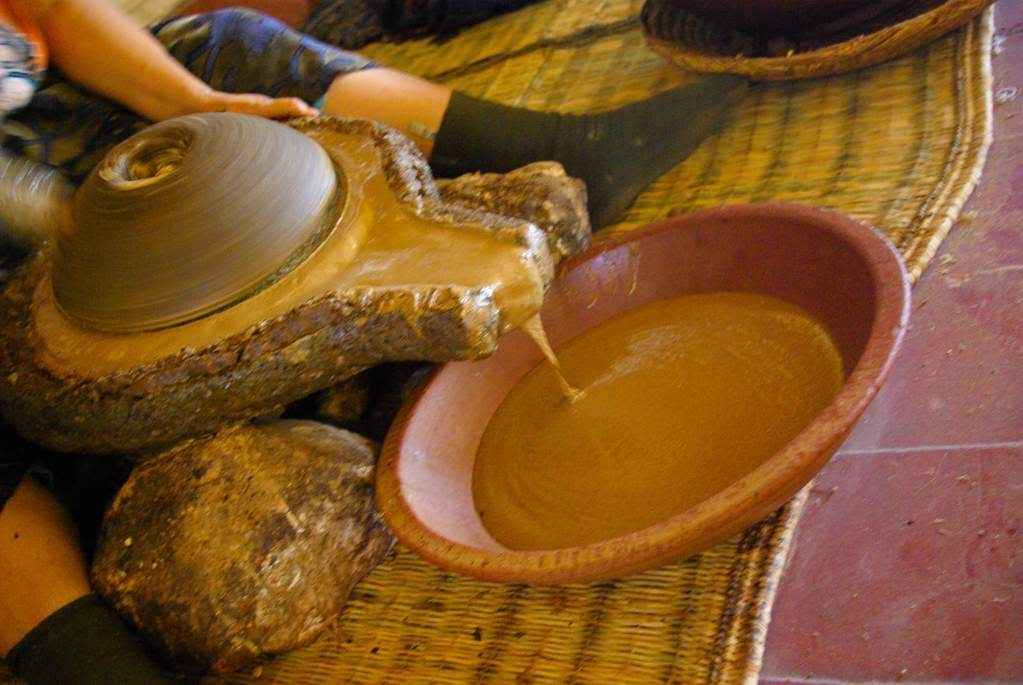
Argan oil is produced by several women's co-operatives in southwest Morocco. The most labour intensive part of oil-extraction is removal of the soft pulp (used as animal feed) and the cracking by hand, between two stones, of the hard nut. The seeds are then removed and gently roasted. This roasting accounts for part of the oil's distinctive, nutty flavour. The traditional technique for oil extraction is to grind the roasted seeds to paste, with a little water, in a stone rotary quern. The paste is then squeezed between hands to extract the oil. The extracted paste is still oil-rich and is used as animal feed. Oil produced by this method will keep 3–6 months, and will be produced as needed in a family, from a store of the kernels, which will keep for 20 years unopened. Dry-pressing is now increasingly important for oil produced for sale, as the oil will keep 12–18 months and extraction is much faster.

The oil contains 80% unsaturated fatty acids, is rich in essential fatty acids and is more resistant to oxidation than olive oil. Argan oil is used for dipping bread, on couscous, salads and similar uses. A dip for bread known as amlou is made from argan oil, almonds and peanuts, sometimes sweetened by honey or sugar. The unroasted oil is traditionally used as a treatment for skin diseases, and has found favour with European cosmetics manufacturers.

Argan oil is sold in Morocco as a luxury item (although difficult to find outside the region of production) and is of increasing interest to cosmetics companies in Europe. It was difficult to buy the oil outside Morocco but by 2001-2002 became a fashionable food in Europe and North America. It is now widely available in specialist shops and occasionally in supermarkets. Its price (USD$40-50 for 500 ml) is notable compared to other oils.

Argan oil contains:

    * 44% Oleic acid
    * 30% Alpha-linolenic acid
    * 12% Palmitic acid
    * 6% Stearidonic acid
    * 5% Linoleic acid
    * 3% Myristic acid

Argan oil is exceptionally rich in natural tocopherols (vitamin E), rich in phenols and phenolic acid, rich in carotenes, rich in squalene, rich in essential fatty acids, 80% unsaturated fatty acids and depending on extraction method more resistant to oxidation than olive oil.

Argan oil is used for dipping bread, on couscous, salads and similar uses. "Amlou" a thick brown paste with a consistency similar to peanut butter is produced by stone grinding roasted almond and Argan oil and is considered a favorite local bread dip. The unroasted oil is traditionally used as a treatment for skin diseases, and has found favour with the cosmetics industry.

Supporting Women

All argan sold today is produced by a women's cooperative that shares the profits among the local women of the Berber tribe. The cooperative has established an ecosystem reforestation project so that the supply of argan oil will not run out and the income that is currently supporting the women will not disappear. The money is providing healthcare and education to the local women, and supporting the entire community as a whole.

Josie Maran Argan Oil

Psoriasis is an inflammatory disease, which typically causes red scaly patches on the skin. Psoriasis can be developed at any age, and the severity o the disease can vary as well. There are countless prescription and harsh medical treatments, such as steroid injections. It is not strange to spend years looking for something that works for you, and spending lots and lots of money figuring it out. Argan oil psoriasis products are an affordable, natural solution.

Argan oil psoriasis is a great solution for psoriasis. 100% Organic Argan Oil is a moisturizer and an anti-inflammatory, exactly what is needed for psoriasis. Argan oil Psoriasis sufferers can have visible improvement after just a few weeks, and can completely heal within 9 weeks of regular application of argan oil. These results can only be achieved with pure and organic argan. Not only does argan oil help with psoriasis, it is also reportedly great for hair, skin and nails because of its extremely high content of amino acids, antioxidants, and vitamin E.

Because organic argan oil has anti-inflammatory and moisturizing qualities it can help with a variety of skin conditions. Leslie S. Baumann, MD, an expert in the area of cosmetic ingredients, and the director of cosmetic dermatology at the Miller School of Medicine at the University of Miami, agrees that argan oil psoriasis can help treat skin conditions such as psoriasis and eczema.

Argan oil, when it is pure and natural, helps dry skin and oily skin, sounds a bit odd, but the nourishing effects of vitamin E and the free radical reducing and anti-inflammatory properties of the antioxidants and amino acids allow the oil to help with conditions like psoriasis, acne and eczema. Both women and men, young and old, can use argan oil psoriasis products. Argan oil is even great for pregnant women because the moisturizing properties prevent the formation of stretch marks when massaged on skin regularly.

Josie Maran Argan Oil contains such small traces of argan oil in her cosmetic products that they do not retain the effectiveness for which argan oil is known. Josie maran argan oil eye shadow or mascara with a drop of argan oil and the rest of the additives is not going to moisturize your eyelids and your eyelashes, so don’t expect that. If you want good quality argan oil, from a company that does one thing and only one thing, head to Amal Oils 100% Organic Argan Oil.

You want to stay away from argan oil products that contain pungent smells and feel greasy, like Josie Maran argan oil. A strong smelling or greasy feeling argan oil indicates that it is expired, not pure, or has been pressed by hand. When argan oil is pressed by hand, it is mixed with local, not purified, and definitely non-organic water. The water is necessary when pressed by hand because it stimulates the oil to release from the argan nuts.

Revitalize Your Hair with Argan Oil

Exclusively found in the calcareous semi desert of southwestern Morocco, the Argan tree's fruit is the source of the Argan oil. Argan oil is produced from the kernels of the tree.
The oil is extracted manually through a process that involves stripping the soft pulp of the Argan fruit from the nuts, drying the nuts in the sun, and using stones to crack open the nuts so the seeds can be obtained from them. The seeds are then roasted to give the oil in the seeds a rich nutty flavor before a little water is added and the nuts are ground into a thick paste. The paste is then simply squeezed with hand to obtain the oil.
Because the Argan tree is only found in a few regions in Morocco, the oil is produced and supplied in small quantities and is hard to find. This is why it is also referred to as the liquid gold.
Although Argan oil has been used for other purposes, such as dipping bread, on salads, making couscous, and other cooking usages, it is much suitable for you to use it in skin and hair treatment because of the high percentage it has in essential fatty acids. The oil consists of a blend of various fatty acids, vitamin E, Phenols, and Carotenes. It contains unsaturated fatty acids in the following percentages;

  • Strearic acids – 6.0 %
  • Palmitic acids – 12.0 %
  • Linoleic acids – 36.8 %
  • Oleic acids – 42.8 %
The oil is also popular because of the effects it has on the skin. Below are some of the ingredients of Argan oil, that make it suitable for your skin.
Vitamin F (omega 6)
Omega F is a major nutrient of the Argan oil that helps your skin to fight aging and skin dryness. It acts as your anti aging and anti dryness agent.
Vitamin E
The presence of vitamin E in your skin treatment acts as a powerful antioxidant and anti-inflammatory for sensitive skin. It also neutralizes free harmful radicals on your skin making it less likely to be attacked by bacteria.
Squalene
Squalene is an important inclusion in your skin care products, as it has proved to be a major agent that helps to fight against skin cancer.
Triterpens
They help in the restructuring of skin cells, and are therefore responsible for smooth and healthy skins.
Phenols
Similar to vitamin E, phenols act as antioxidants and anti-inflammatory agents. They activate and increase the action of vitamin C forming a powerful protection against bacteria and fungus.

Argan Oil Benefits

Argan Oil is therefore a rare, precious oil and has become famous for its many benefits. Its beauty secrets, although simple, have been known for centuries by the women of Morocco who have used it traditionally in the daily care of their care of skin and hair. It regenerates the skin, restarts the vital functions of the cells and the growth process, neutralizes free radicals and it is extremely nutritious.

A lot of these natural hair products can also make good organic skin products as well. Such as using the Argan Oil and shea butter. So by using natural hair products you can also reap the benefits of keep your skin ageless by using these same products on your skin as well. And ways that you could keep them separated is to use separate what you will be using on skin and what you will be using on your hair, as to not cross contaminate them.

Relieve eczema and psoriasis Argan oil is one of the world's richest natural sources of vitamin E, so is a great treatment for a variety of skin conditions. Alleviate dry, itchy scalp Apply to scalp and wrap head in a warm towel for 30 minutes or overnight to soothe irritation.

Argan Oil is naturally-derived from the Argan plant, indigenous to Morocco. Argan Oil has been shown to be effective at reducing frizz, adding shine, and increasing (infusing) natural hydration. Dimethicone and Isopropyl Myristate provide a thin, protective coating the hair that helps protect from damage caused by flat irons, curling irons and blow drying.

Make sure you are buying authentic argon oil. If you are buying argon oil from a reputable (online) retailer in the USA or Europe, you can skip this tip and go straight to #2. However, if you are planning on purchasing the oil while visiting Morocco or from an unfamiliar retailer, then please read on.

Jojoba Oil is naturally-derived from shrubs indigenous to the western U.S. It has been used extensively for hair care to increase the cleaning action for its properties to remove dirt, unclog follicle pores and to provide protective coating to the follicle shaft and root.

Other ways that are best for caring for natural hair is to cut out using as many electronic products as possible. Now if you are African American with natural hair you might use a pressing comb once a week or so depending on the type of climate that you are living in. But I find that using a hair dryer and either wrapping up my hair or doing a roller set works for me.

Soften dry, cracked skin Argan oil has a very high content of unsaturated fatty acids, even more so than shea butter, making it the perfect all-over face, hand and body moisturizer. Its' primary benefit seems to come from its ability to naturally hydrate and to help stop frizziness, fly-away and hard to control, unmanageable hair.

Used during the day and night the oil regenerates your skin, moisturises it and prevents early signs of aging increased by the external factors such as the sun, bad weather, the stress... The Oil is suitable for all types of skins. It is acts wonders on wrinkles, dry and stretched skin.

Argan Oil – How To Use It?

Moroccan argan oil or “liquid gold” are very precious natural oil, which is rich in vitamin E, omega 3 fatty acids and omega 6 fatty acids; it can be used as facial massage, nail, hair and body skin, and also can be used as food.
The following is tips of using argan oil for facial, body, hair and nails:
Facial Beauty
If you are using cosmetic argan oil, you only need to use a few drops on your entire face. A little bit of oil can hold for a long time, you can use it as a facial moisturizer at night, or used before make-up in the morning. This oil is very easy to penetrate and will not leave any oily substances. It can also be used in the eye area.
Method:
1.Get your face clean with cleaner.
2.Next, use the toner or cold water splashed on your face.
3.Finally, get a few drops of argan oil on your fingers; gently rub wide it in your palm, and then smear on the face or around the eye. If you have extra time, spend a few minutes to massage your skin gently. Gently pat around the eye area to make it easier penetrate.
Body Care
After shower, simply smear the argan oil on your body and wait for few minute before wear clothes or go to sleep.
Hair Care
In order to improve the dry hair/scalp problems, and enhance its brightness, you can apply a large numbers of agran oil on your dry hair, and then wrapped in a warm towel and keep for 30 minutes. Wash your hair normally after that, and it will be nice.
Nail Care
If your nails and cuticles look serious wear and tear, simple soak your nails into the mixture of argan oil and lemon juice for about 10 minutes (or overnight). Not only have to soften cuticles and help prevent your nails break, but also had a healthy nails for you.
You can start using the argan oil at evening to see how the skin reaction, and you can increased to 2 times a day when your skin need extra moisture, or you can be directly applied to wrinkle-prone areas.
Argan oil has a unique natural scent and maybe unsuitable used for those people has odor-sensitive. If this is the case, please select aromatherapy oil or consult your pharmacists.
Do you know only women are involved in manufacturing argan oil? And manufacture of 1 liter of argan oil requirement of 100 kilograms of fresh fruit and 12 hours of hard work?

Liquid Gold in Morocco

The road from Marrakesh to Essaouira is craggy and bleak, an arid moonscape dotted only by a few roadside towns and the occasional Berber village. In the ’60s and ’70s, Essaouira was a stop on the hash-filled hippie trek — land in Marrakesh, load up your magic bus and head west for the windswept beaches and clear blue waters of this former Portuguese fishing village. Back then, Jimi Hendrix made the pilgrimage, as did Bob Marley and Cat Stevens. Essaouira still has remnants of its boho past: crocheted Rasta beanies are sold alongside fezzes in the souk; surfers come to lap up the waves in what is now one of the world’s top windsurfing and kiteboarding spots; and a dilapidated fort, which legend has it was the inspiration for Hendrix’s “Castles Made of Sand” (he actually recorded the song nearly two years before touching down here), is just south of town.
Skip to next paragraph
Morocco Travel Guide
Go to the Morocco Travel Guide »
Multimedia
The Oil of the Argan TreeSlide Show
The Oil of the Argan Tree
Tara Darby

Sometimes you can spot goats up in Essaouira’s argan trees, feasting on the fruit. More Photos »

In recent years, well-heeled Europeans have started to flee the more touristy Marrakesh for Essaouira, where they stay in luxurious riads in the medina and sunbathe on the pristine white beaches. The town has also developed a vibrant cultural life, with galleries, music festivals and souks filled with high-end artisanal crafts. You can pick up everything from carved wooden instruments to inlaid boxes here. The real find, however, is argan oil, made from the nuts of the argan tree, which grows almost exclusively in this region. The oil, which is said to have restorative and age-defying effects, has become one of the latest miracle ingredients in the beauty industry. High in vitamin E and essential fatty acids, it is believed to help all sorts of skin conditions: dry skin, acne, psoriasis, eczema, wrinkles. Moroccans slather it on their skin, hair, nails and even their babies. They eat it, too — drizzling it over salads and couscous, or using it to make amlou, a tahinilike spread of the oil, almonds and honey.

Approaching Essaouira’s sandy-colored ramparts, passing the olive groves and grazing donkeys, you see signs announcing women-run argan cooperatives: Argan Co-Op, Women’s Argan Collective, Miracle Oil. And so on. If you pull over to a cooperative, the Berber women — and it is only women who make argan oil — will often invite you in to watch them work. In most of the cooperatives, the older village women sit in the courtyard and work as the younger bilingual girls walk you around, giving a tutorial about the process. (Pull over too many times, though, and be prepared to hear all about the process again. And again.)

The nuts, which look like a cross between a walnut and an almond, are picked out of the fruit of the squat, gnarled argan trees that dot the yellow hills above Essaouira. Depending on the season, there might be goats up in the branches, munching on the fruit. The nuts destined for salad oil are roasted on an open flame over a large steel drum, like chestnuts, which brings out their distinctive peppery flavor; those that will be used for skin- and hair-care products are left raw.

The women first crack the shells with sharp stones. They then place the kernels between two Flintstone-size slabs of rock, grinding them into a brown paste, which resembles chunky peanut butter. The paste, kneaded by hand to extract the oil, transforms into a solid hunk and is sent to nearby factories, mainly in Agadir, where more oil is extracted by a press. Some is made into soaps, creams and shampoos, but it is the pure oil that is most sought after.

The souks of Essaouira are filled with little jars of argan oil that have suspicious locals rolling their eyes. “Vegetable oil,” they’ll warn you. (Check the bottle for provenance; if it has a cooperative’s name on the label, it’s probably authentic.) The best way to find the real deal is to follow the smell of roasted nuts that will lead you to the cooperatives.

Argan is not so new in Europe: English and French tourists have been bringing it back from Moroccan seaside vacations for years, and it’s all over the markets of Provence, lined up next to the lavender and olive oils. But now, thanks to the substantial efforts of the Moroccan King Mohammed VI (who has been praised for his efforts to promote women’s rights) and the local government, the oil is being exported worldwide, moving from the mud-and-stone co-ops into spas and Sephoras around the world.

Because the extraction of argan oil is a labor-intensive task perfected by the Berber women native to the area (it takes a few days to produce one liter), the government has established a fund for the cooperatives. Outside groups, like the government of Monaco, have gotten involved as backers. Women from the villages nearby are invited to work half days (so they can still tend to their families) in exchange for fair wages and good working conditions. Eventually, the cooperatives should pay for themselves. Unesco has designated the 10,000-square-mile argan-growing region as a biosphere reserve.

Meanwhile, more Western cosmetic companies are starting to distribute this “liquid gold,” as it is often called. Liz Earle, who runs an organic skin-care line in England, uses argan oil that she buys from two of the cooperatives in Essaouira in her Superskin Concentrate. “When I first found argan oil, I brought it back to the U.K. to have it analyzed,” says Earle, who forages the globe for raw ingredients. “It was so remarkably high in vitamin E and had these very interesting phytosterols, which are good for scar tissue and so many other things” — including, she says, that hard-to-define problem of lackluster skin.

But what Earle likes most about the oil is that the production passes the sustainability test and directly benefits the women who make it. “Culturally, what it does is good,” she says. “It provides income to a group that wouldn’t otherwise have it.”